Unisannio–CIRA research: conformal metasurfaces for next-generation wireless networks
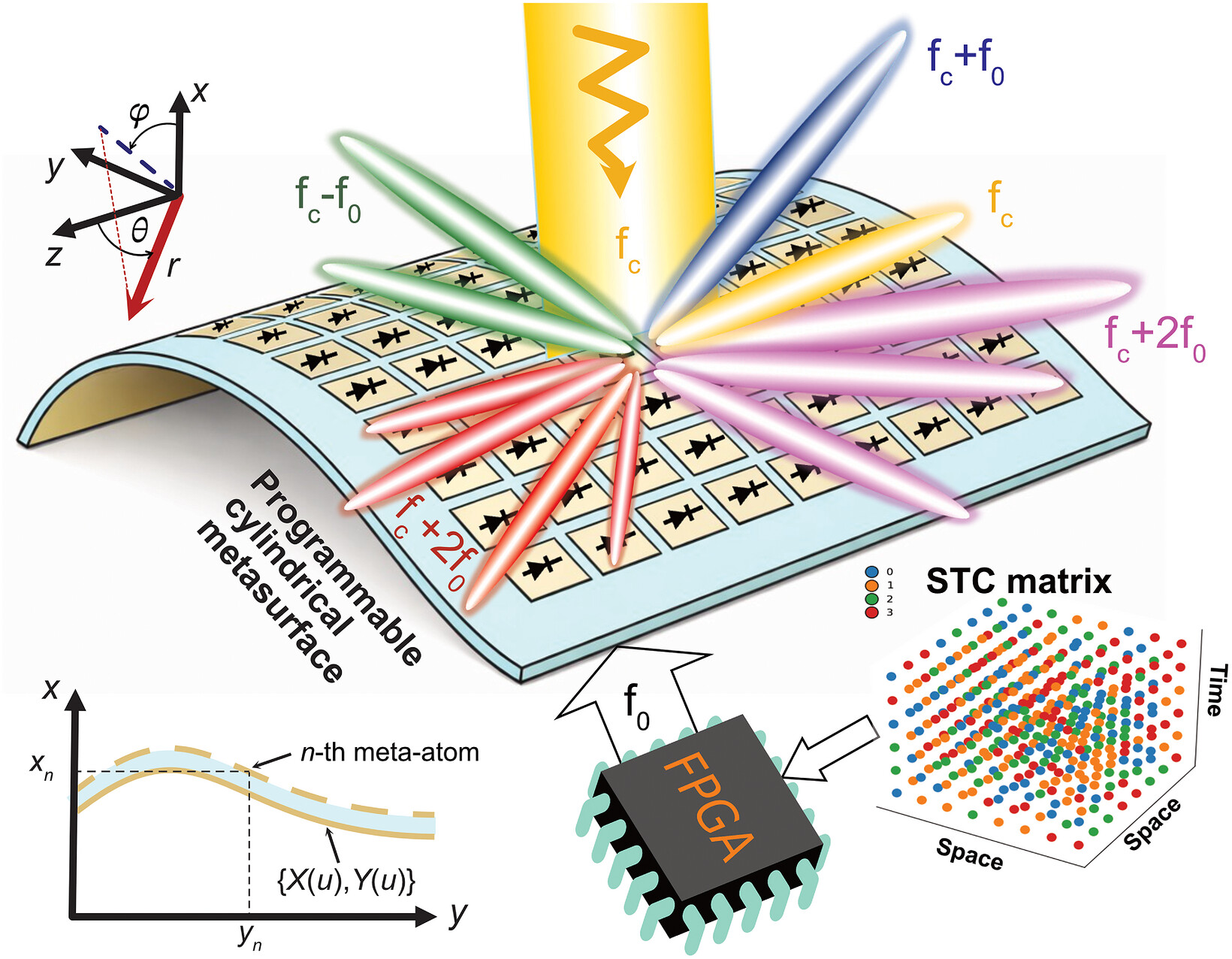
Drones, aircraft, vehicles, satellites, urban infrastructure, and mobile platforms rarely have flat surfaces. For this reason, one of the most important challenges in the development of future electromagnetic technologies is to make intelligent surfaces not only programmable, but also conformal, that is, capable of adapting to curved and realistic geometries. This is the context of a new study carried out with the contribution of the CIRA, dedicated to metasurfaces capable of dynamically controlling electromagnetic waves on nonplanar surfaces.
The work, titled “Space-Time Coding Conformal Metasurfaces for Multifrequency Beam Steering and Shaping,” has been published in Advanced Materials, one of the most selective journals in the field of functional materials, metamaterials, and metasurfaces. The study is authored by Filippo Pepe, Lei Zhang, Yi Ning Zheng, Xiao Qing Chen, Ivan Iudice, Giuseppe Castaldi, Marco Di Renzo, Tie Jun Cui, and Vincenzo Galdi, and involves the collaboration of CIRA – Italian Aerospace Research Centre, the Fields & Waves Lab of the Department of Engineering of the University of Sannio, Southeast University in Nanjing, and Professor Marco Di Renzo, a telecommunications professor at CNRS/CentraleSupélec and King’s College London.
Metasurfaces are ultrathin artificial structures capable of modifying the propagation of electromagnetic waves. The new frontier is represented by space-time-coding metasurfaces, which introduce joint programming in space and time: they are therefore not limited to controlling the direction of a wave, but can generate different responses across multiple frequency components. This capability paves the way for multifunctional platforms for advanced wireless communications, reconfigurable intelligent surfaces, dynamic spectrum control, and integrated sensing and communication systems.
The published research extends this paradigm to conformal metasurfaces, that is, curved surfaces designed to follow the actual shape of the platforms on which they can be installed. This represents a crucial step beyond planar configurations, which are easier to model and fabricate but less representative of real application scenarios. The work demonstrates that a single conformal aperture can manipulate different frequency components, enabling functions such as beam steering, beam shaping, beam splitting, and diffuse scattering.
The approach combines electromagnetic modeling, semi-analytical synthesis, and evolutionary optimization with experimental validation carried out using a programmable X-band prototype, mounted on a mechanically reconfigurable support capable of assuming different cylindrical geometries. The experimental work, conducted at Southeast University, verified the platform’s ability to generate different electromagnetic responses at different harmonic components, demonstrating the feasibility of multifrequency control on curved surfaces.
The work is part of the industrial PhD program of Filippo Pepe, carried out between the CIRA and University of Sannio, and represents a tangible example of integration among academic research, aerospace expertise, advanced experimentation, and international scientific collaboration.
According to Ivan Iudice, researcher at CIRA, this activity is particularly relevant as it focuses on the development of technologies that could potentially be integrated into aerospace platforms and complex systems, where surfaces are rarely flat.
These results open up perspectives for reconfigurable intelligent surfaces, next-generation wireless communications, integrated sensing and communication systems, dynamic spectrum control, and applications on mobile or aerospace platforms.
The publication confirms the value of collaboration among universities, research centres, and international partners in advancing enabling technologies for future wireless networks and electromagnetic systems.
Link to the article: https://advanced.onlinelibrary.wiley.com/doi/10.1002/adma.73837