CIRA develops Digital Twins of its space qualification facilities
As part of the development plan for the Space Qualification Center, CIRA is carrying out a dedicated program to build Digital Twins of its test facilities, alongside the implementation of new experimental infrastructures aimed at expanding qualification capabilities. The objective is to integrate advanced digital models with experimental testing, enhancing the analysis, simulation, and verification capabilities of space components and subsystems.
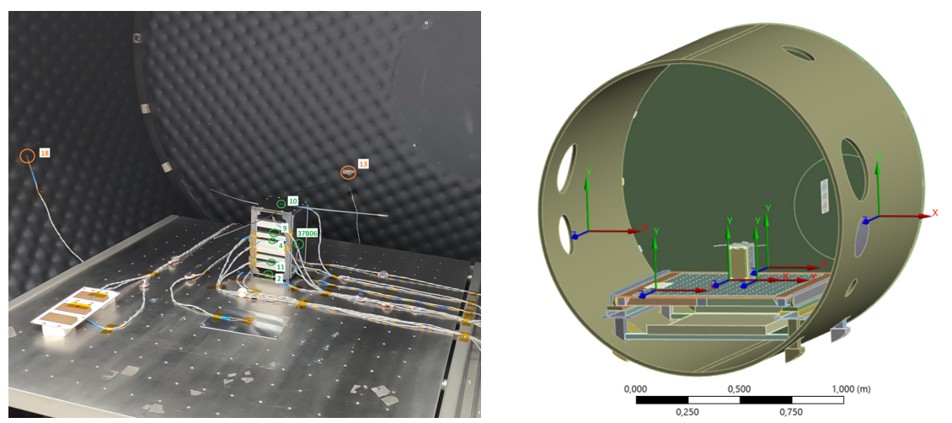
For the thermal vacuum facility, two Master’s theses in Aerospace Engineering were successfully completed in collaboration with the Department of Mechanical and Aerospace Engineering at the Politecnico di Torino, under the supervision of Prof. R. Fusaro and Dr. R. Scigliano. The works focused on the development and application of the Digital Twin to space qualification, with particular reference to CIRA's thermal vacuum chamber:
- “Digital Twin for a Space Qualification Test Facility: CIRA’s Thermal Vacuum Chamber”, by Paolo Tropini, Eng.;
- “Digital Twin for Space Qualification: Optimizing Virtual and Physical Testing for Space Components”, by Enrica Guarino, Eng.
The research results were presented at international scientific conferences, including the 3rd International Conference on Flight Vehicles, Aerothermodynamics and Re-entry (FAR), held in Arcachon, France, from May 18 to 22, 2025, and the 10th CEAS Aerospace Europe Conference, 28th AIDAA Congress, 10th Aerospace & Defense Meeting, held in Turin from December 1 to 4, 2025.
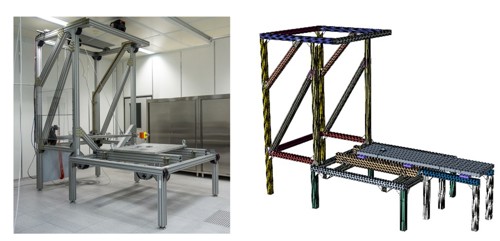
Digital Twin development activities also involved the pyroshock facility, dedicated to simulating mechanical impulsive loads that can occur during operational phases of space systems. In this context, Dr. S. Saputo presented the scientific contribution “Digital Twin Development and Experimental Correlation of an Explicit FEM Pyroshock Qualification Test Facility” at the ISMA 2026 international conference, held in Leuven, Belgium, from September 7 to 9, 2026. The paper addressed the development of a numerical model based on the explicit finite element method and its correlation with the facility’s experimental results—a crucial step in evaluating the reliability of the digital model in replicating the dynamic behavior of the test system.
Taken together, these activities highlight the potential of the Digital Twin approach within space qualification. The integration of numerical modeling, simulation, and experimental validation makes it possible to deepen the understanding of the physical phenomena involved, improve the predictive capacity of models, and identify new opportunities to optimize testing campaigns. Furthermore, the results achieved form a baseline for subsequent methodological and technological developments required to progressively extend the use of virtual simulations, up to evaluating the possibility of conducting fully virtual qualification activities, where permitted by applicable standards, regulations, and required validation levels.
These initiatives mark a significant step forward in the innovation roadmap of CIRA's Space Qualification Center, contributing to the development of advanced methodologies for increasingly integrated, efficient, and digitally supported qualification, ultimately benefiting the reliability and performance of systems intended for space applications.